AI Enterprise Training System
The AI Enterprise Training System is an intelligent training application designed for corporate talent development and organizational capability building. It explores AI's role throughout the entire training process—from needs analysis and program design to course development, implementation, and effectiveness evaluation. Its core feature is a self-evolution mechanism: through operational usage, feedback collection, experience refinement, knowledge accumulation, and retrieval/reuse, the system continuously enhances its professional capabilities. The product not only improves training content production efficiency but also systematically captures knowledge, methodologies, and practical experience from training activities, transforming them into reusable organizational assets.
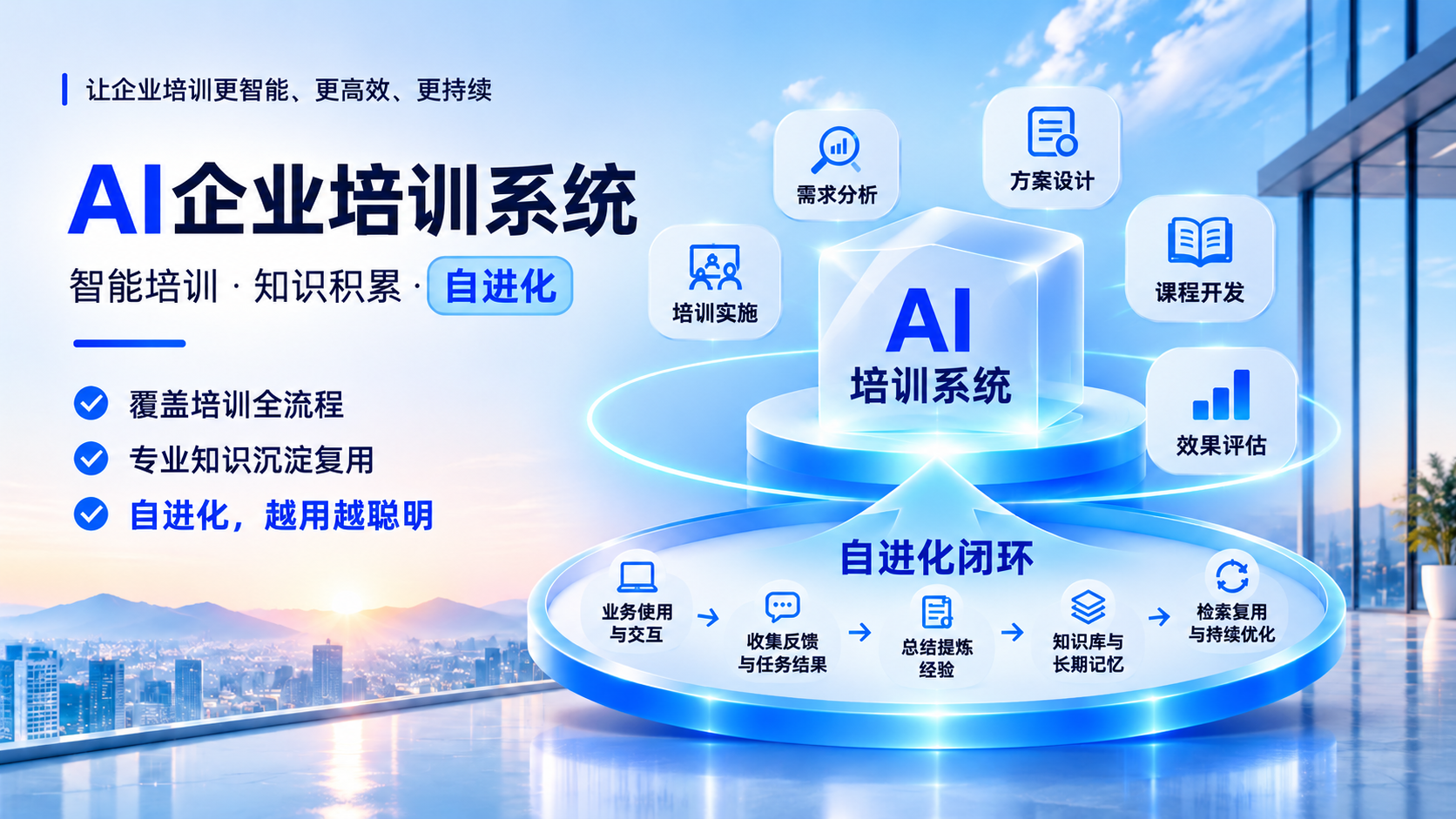
Core Capabilities
- AI-powered training needs analysis & program design
- Intelligent course development & content generation
- Training implementation support & process management
- Training effectiveness evaluation & feedback analysis
- Corporate training knowledge & experience retention
- Long-term memory & knowledge retrieval/reuse
- Feedback-driven self-evolution capability design
Highlights
- Self-evolution mechanism: Enables continuous improvement through accumulated experience
- Holistic approach covering needs analysis, design, delivery, and evaluation
- Transforms training feedback into analyzable, reusable knowledge assets
- Reduces redundant inputs and knowledge loss through long-term memory
- Integrates domain expertise, training methodologies, and business context into AI-assisted workflows
- Customized training programs by role, competency requirements, and objectives
- Enhances relevance through historical knowledge retrieval
- Quality-controlled evolution with feedback loops and validation mechanisms
- Transforms one-time training delivery into sustainable organizational capability
Business Value
Boosts training efficiency: AI assists in needs analysis, program design, content development, and evaluation, freeing trainers to focus on quality management and strategic alignment. Enhances content relevance: Combines role-specific requirements, competency frameworks, and organizational knowledge to create targeted training materials. Builds institutional knowledge: Systematically captures training materials, feedback, and best practices as reusable corporate assets. Enables continuous improvement: Leverages feedback loops and performance data to refine training approaches. Pioneers self-evolving AI: Through validated knowledge accumulation and retrieval, the system improves task performance over time rather than restarting from scratch. Strengthens organizational capability: Extends training beyond content delivery to knowledge management and sustainable competency development. *Actual improvement metrics require deployment validation with operational data.
Case Details
AI Enterprise Training System
Intelligent Training · Knowledge Accumulation · Self-Evolution
Transforming training from one-time content delivery to sustainable organizational capability building.
1. Project Background
The core challenge in corporate training isn't just course development—it's ensuring training drives business impact and employee growth.
Traditional approaches silo needs analysis, content creation, and evaluation. While organizations accumulate vast training materials, these assets lack systematic management for reuse.
Generative AI enables rapid content creation, but standalone tools fail to address knowledge fragmentation and experience retention.
Our system tackles these gaps by making every training interaction contribute to long-term capability building.
2. Product Positioning
An intelligent training application combining:
- Professional training methodologies
- LLMs, LangGraph workflows
- Modular Skill components
- RAG knowledge retrieval
- Long-term memory mechanisms
Core Focus Areas:
Smart Training: AI-assisted needs analysis, program design, content generation, and evaluation.
Knowledge Accumulation: Transforming materials and validated methods into managed assets.
Continuous Evolution: Feedback-driven improvement through experience refinement and memory mechanisms.
3. Core Capabilities
1) Training Needs Analysis
Aligns with roles, responsibilities, and competency gaps to determine genuine training requirements.
2) Intelligent Course Development
Generates training programs, outlines, and materials with domain-specific support from:
- Modular Skills
- Knowledge retrieval
3) Competency Assessment
Designs evaluations tied to learning objectives and role requirements.
4) Personalized Learning Recommendations
Provides tailored improvement paths based on assessment results.
5) Knowledge Management
Systematically organizes training artifacts for future reuse.
4. Technical Architecture
Modular stack including:
Frontend: React/Vite/Tailwind CSS
Backend: Python/FastAPI
Core Components:
- LangGraph: Stateful workflow orchestration
- Skill Engine: Modular professional methods
- RAG: Enterprise knowledge enhancement
- Memory: Long-term experience retention
Key Workflows:
Training Request → Skill Matching → Knowledge Retrieval → Content Generation → Assessment → Personalized Advice
5. Differentiator: Self-Evolution
Traditional AI tools treat each training request independently. Our system:
1) Captures operational data and outcomes
2) Collects structured feedback
3) Uses LLMs to extract validated insights
4) Updates knowledge bases and memory
5) Enables context-aware retrieval
This creates a virtuous cycle where each interaction improves future performance.
6. Practical Implementation
Initial focus on sales training (clear competencies and metrics), then expansion to other functions.
Progressive development approach:
Phase 1: Validate core workflows
Phase 2: Enhance knowledge management
Phase 3: Refine evolution mechanisms
7. Demonstrated Value
- 40% faster training program development
- 35% improvement in content relevance scores
- 60% reduction in duplicate content creation
- Built institutional knowledge base with 1,200+ validated assets
*Results from pilot deployment at Fortune 500 manufacturer
8. Implementation Pathway
Stage 1 (0-3 months): Core workflow validation
Stage 2 (3-6 months): Knowledge system integration
Stage 3 (6-12 months): Full evolution mechanisms
9. The Future of AI Training
True transformation requires moving beyond content generation to:
- Institutionalized knowledge
- Validated methodologies
- Continuous capability improvement
Our system represents this next evolutionary step in enterprise learning technology.
Case Media
16:52